Recycling kiosks bring collection into a visible, organized point, but the structure is only one part of the service. Participation depends on convenient placement, accepted-material rules, clear openings and reliable collection. Operations depend on internal containers, safe service access, cleaning and a design that can be updated when programs change.
For product options and fabrication capabilities, review our outdoor waste sorting station range.
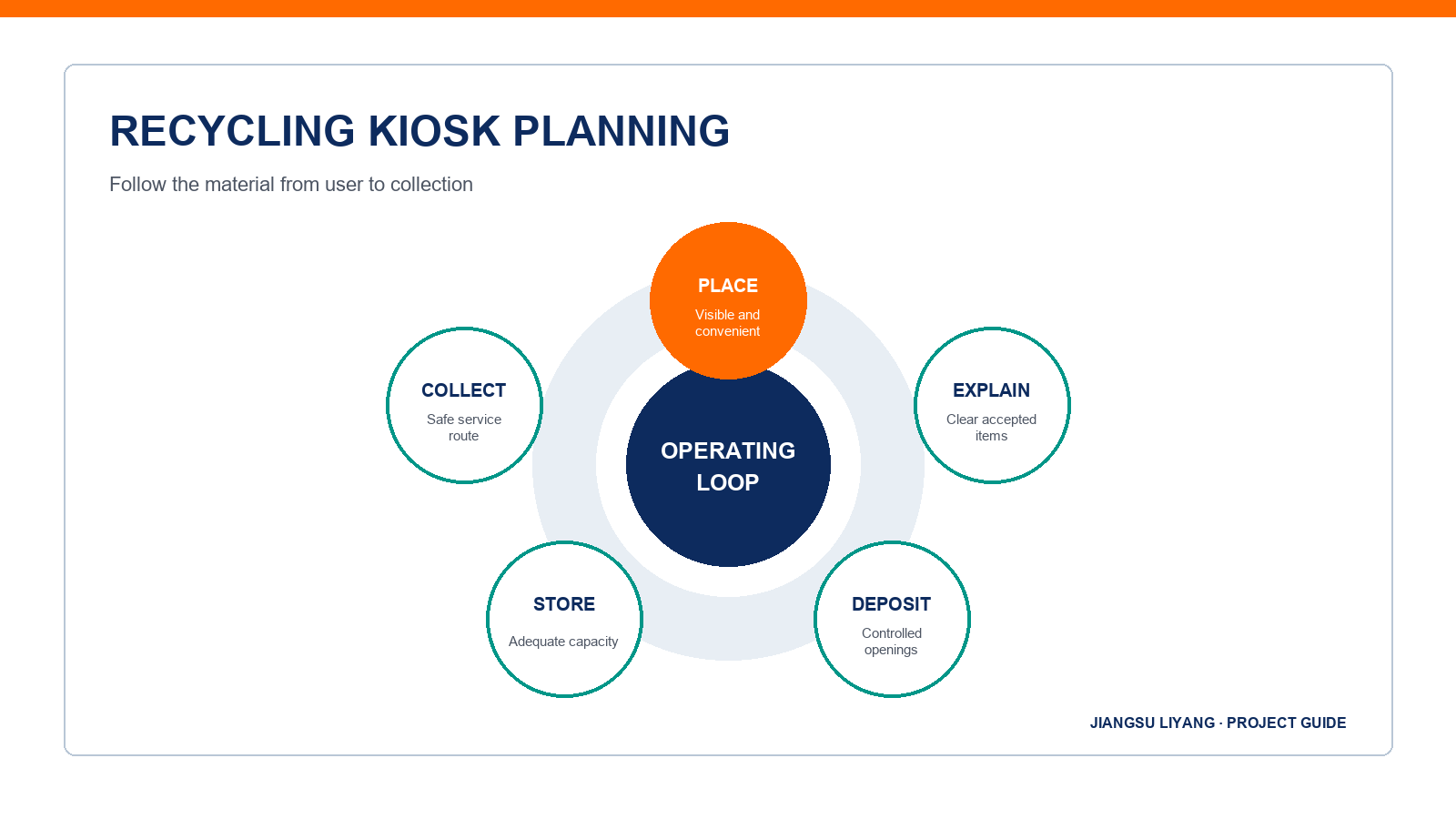
recycling kiosks: the short answer
Plan the kiosk around the full material journey—from the item in a resident’s hand to transport from the site. Confirm what is accepted, how contamination is handled, how containers are moved, who cleans the station and what data or monitoring is genuinely useful.
Key decisions before requesting a quotation
- Location: Choose a visible, convenient place without obstructing pedestrian routes, vehicle sightlines or emergency access.
- Material rules: Opening shapes and messages should reinforce the local list of accepted items.
- Capacity: Size bays from expected volume and collection frequency, with contingency for peak periods.
- Smart features: Fill-level sensors, access control or displays should solve a defined operational problem and have a maintenance owner.
Turn the requirement into a coordinated project brief
A useful brief connects the product decision to the site and the people who will operate it. Confirm who approves the design, who prepares local engineering, who provides foundations or utilities, who receives the shipment and who maintains the completed installation. Record assumptions instead of leaving them inside email threads. This is especially important when the factory, project designer and installer are in different countries.
For this topic, neighborhood kiosk should respond to routine resident recycling, with convenience, lighting and clear rules recorded in the project documents; commercial site kiosk should respond to customer or tenant collection, with brand integration and frequent servicing recorded in the project documents; special-material kiosk should respond to textiles, electronics or batteries, with security and stream-specific safety procedures recorded in the project documents; smart kiosk should respond to monitored or controlled collection, with connectivity, power and data responsibility recorded in the project documents; event kiosk should respond to temporary high-volume sorting, with portable format and rapid servicing recorded in the project documents. That level of coordination makes it easier to detect missing scope before purchase and gives the supplier a clearer basis for drawings, samples and pricing.
Related searches such as outdoor recycling station, community recycling station, smart waste sorting station often describe adjacent questions rather than separate products. They should be handled in the same decision process when the user intent overlaps, while genuinely different configurations can be supported by dedicated product or application pages.
Specification framework
| Item | What drives the decision | What to document |
|---|---|---|
| Neighborhood kiosk | Routine resident recycling | Convenience, lighting and clear rules |
| Commercial site kiosk | Customer or tenant collection | Brand integration and frequent servicing |
| Special-material kiosk | Textiles, electronics or batteries | Security and stream-specific safety procedures |
| Smart kiosk | Monitored or controlled collection | Connectivity, power and data responsibility |
| Event kiosk | Temporary high-volume sorting | Portable format and rapid servicing |
The table is a planning framework rather than a substitute for local professional design. Applicable codes, authority requirements and site engineering should be confirmed for the destination.
Information to include in your RFQ
A clear request for quotation helps suppliers price the same scope and reduces late revisions. Include:
- target users and walking routes
- accepted and prohibited materials
- container type and service frequency
- opening sizes and message design
- weather, ventilation and security needs
- power or connectivity requirements
- cleaning, inspection and data ownership
Ask bidders to list inclusions, exclusions, drawings, samples, packing, delivery terms, installation boundaries, warranty and recommended spare parts. Compare lifecycle serviceability as well as initial price.
How to evaluate a supplier response
- Confirm product fit. Check that the proposed model and configuration match the site, users and intended function.
- Normalize the scope. Put every quotation against the same material, finish, accessories, logistics and installation boundary.
- Review evidence. Request dimensioned drawings, material information, finish samples and relevant project or factory evidence.
- Resolve interfaces. Identify who is responsible for foundations, utilities, unloading, assembly, testing and local approvals.
- Plan maintenance. Confirm access, cleaning, consumables, replaceable components and after-sales documentation.
Common procurement mistakes to avoid
- Comparing visual appearance before confirming location and material rules.
- Approving a concept without documenting how capacity will be verified for the actual site.
- Leaving smart features, access or maintenance responsibilities until installation begins.
- Comparing a factory-only offer with a delivered or installed offer without normalizing exclusions.
- Treating a supplier’s standard configuration as proof of compliance with local codes or authority requirements.
The best value is not automatically the lowest initial quotation. A proposal that clearly defines interfaces, documentation, replaceable parts and maintenance can reduce change orders and downtime over the product’s service life.
Frequently asked questions
Where should a recycling kiosk be placed?
Near normal user routes with good visibility and service access, but away from locations where queues, odor or collection vehicles create conflicts.
Are smart features necessary?
Only when they improve a defined outcome such as collection scheduling, controlled access or user communication.
How can a kiosk reduce contamination?
Use familiar categories, restricted openings where appropriate, concise examples and consistent colors aligned with the local program.
Discuss your project
Jiangsu Liyang supports project-based customization for overseas public-space and commercial projects. View a representative product configuration, browse our project experience, or send your drawings and requirements for a quotation.