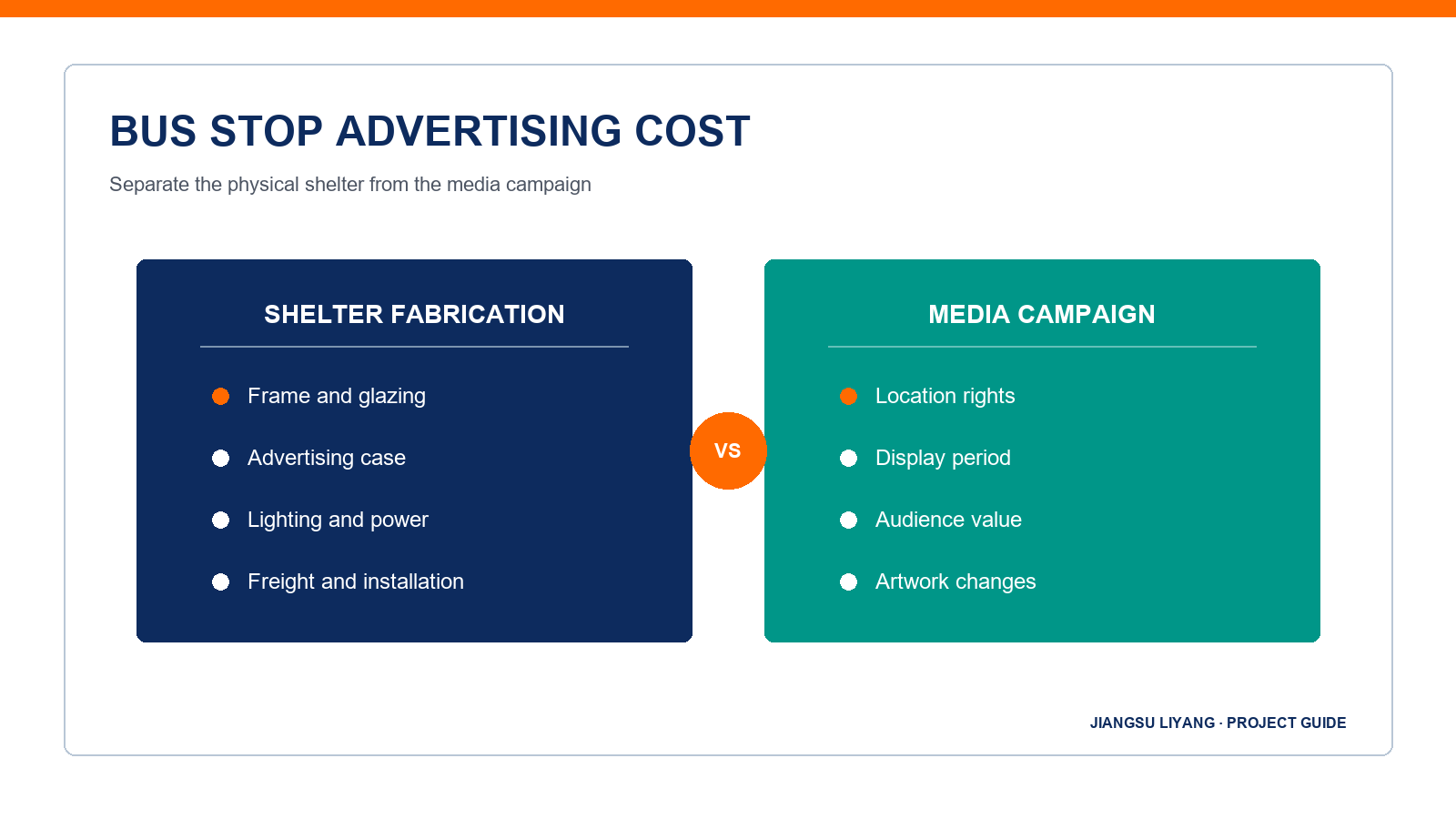
Bus stop advertising cost can mean two very different things: the media fee paid to display a campaign, or the cost of manufacturing a shelter with advertising panels. Buyers should separate these budgets at the beginning. A shelter manufacturer normally quotes the physical structure, display case, lighting and related hardware; a media owner or local operator controls campaign rates, audience data and display periods.
For product options and fabrication capabilities, review our custom bus shelter range.
bus stop advertising cost: the short answer
For a fabrication quote, price is driven by shelter size, structural material, glazing, poster or digital display format, illumination, electrical work, finish, quantity, freight and installation. Advertising rates are location-specific and cannot be inferred from the shelter price. Ask suppliers to itemize each scope so construction and media costs are not mixed.
Key decisions before requesting a quotation
- Display format: Static posters use simpler frames and illumination. Digital screens add enclosures, cooling, power, connectivity and service access.
- Panel dimensions: Non-standard media sizes can increase frame, glazing and replacement-parts cost. Confirm visible area and overall case size.
- Lighting and power: Backlit panels require electrical components and safe cable routing; off-grid concepts may require a separate solar assessment.
- Site and quantity: Foundation conditions, traffic management, freight volume and repeat production all change the installed cost.
Turn the requirement into a coordinated project brief
A useful brief connects the product decision to the site and the people who will operate it. Confirm who approves the design, who prepares local engineering, who provides foundations or utilities, who receives the shipment and who maintains the completed installation. Record assumptions instead of leaving them inside email threads. This is especially important when the factory, project designer and installer are in different countries.
For this topic, shelter structure should respond to manufacturer or contractor, with frame, roof, glazing, finish and assembly recorded in the project documents; advertising case should respond to manufacturer, with poster size, door, locks, glazing and illumination recorded in the project documents; civil/electrical work should respond to local installer, with foundation, trenching, connection and permits recorded in the project documents; media rights and campaign should respond to operator or media owner, with location, period, audience and artwork changes recorded in the project documents; maintenance should respond to contract-dependent, with cleaning, lamp or screen service, vandalism repair recorded in the project documents. That level of coordination makes it easier to detect missing scope before purchase and gives the supplier a clearer basis for drawings, samples and pricing.
Related searches such as bus shelter advertising cost, bus stop advertising rates, bus shelter ad dimensions often describe adjacent questions rather than separate products. They should be handled in the same decision process when the user intent overlaps, while genuinely different configurations can be supported by dedicated product or application pages.
Specification framework
| Item | What drives the decision | What to document |
|---|---|---|
| Shelter structure | Manufacturer or contractor | Frame, roof, glazing, finish and assembly |
| Advertising case | Manufacturer | Poster size, door, locks, glazing and illumination |
| Civil/electrical work | Local installer | Foundation, trenching, connection and permits |
| Media rights and campaign | Operator or media owner | Location, period, audience and artwork changes |
| Maintenance | Contract-dependent | Cleaning, lamp or screen service, vandalism repair |
The table is a planning framework rather than a substitute for local professional design. Applicable codes, authority requirements and site engineering should be confirmed for the destination.
Information to include in your RFQ
A clear request for quotation helps suppliers price the same scope and reduces late revisions. Include:
- static poster or digital format
- visible artwork size and case orientation
- single- or double-sided display
- power availability and lighting hours
- anti-vandal and weather-protection requirements
- shelter quantity and installation locations
- responsibility for permits, media rights and maintenance
Ask bidders to list inclusions, exclusions, drawings, samples, packing, delivery terms, installation boundaries, warranty and recommended spare parts. Compare lifecycle serviceability as well as initial price.
How to evaluate a supplier response
- Confirm product fit. Check that the proposed model and configuration match the site, users and intended function.
- Normalize the scope. Put every quotation against the same material, finish, accessories, logistics and installation boundary.
- Review evidence. Request dimensioned drawings, material information, finish samples and relevant project or factory evidence.
- Resolve interfaces. Identify who is responsible for foundations, utilities, unloading, assembly, testing and local approvals.
- Plan maintenance. Confirm access, cleaning, consumables, replaceable components and after-sales documentation.
Common procurement mistakes to avoid
- Comparing visual appearance before confirming display format and panel dimensions.
- Approving a concept without documenting how lighting and power will be verified for the actual site.
- Leaving site and quantity, access or maintenance responsibilities until installation begins.
- Comparing a factory-only offer with a delivered or installed offer without normalizing exclusions.
- Treating a supplier’s standard configuration as proof of compliance with local codes or authority requirements.
The best value is not automatically the lowest initial quotation. A proposal that clearly defines interfaces, documentation, replaceable parts and maintenance can reduce change orders and downtime over the product’s service life.
Frequently asked questions
Does a shelter quote include advertising rights?
Usually not. Fabrication and media placement are separate commercial scopes unless the contract explicitly combines them.
Are digital advertising shelters always more expensive?
They generally require more equipment and site services, but lifecycle cost depends on screen specification, energy, maintenance and revenue model.
How can buyers compare quotations?
Issue the same panel dimensions, materials, lighting scope, installation boundary and warranty questions to every bidder.
Discuss your project
Jiangsu Liyang supports project-based customization for overseas public-space and commercial projects. View a representative product configuration, browse our project experience, or send your drawings and requirements for a quotation.