
Bridge pedestrian railing sits at a critical interface between public safety, structural design, drainage, bridge movement and architectural appearance. It cannot be treated as a decorative product added after the deck is complete. Post spacing, anchor zones, joints and transitions need early coordination with the bridge designer.
For product options and fabrication capabilities, review our pedestrian railing range.
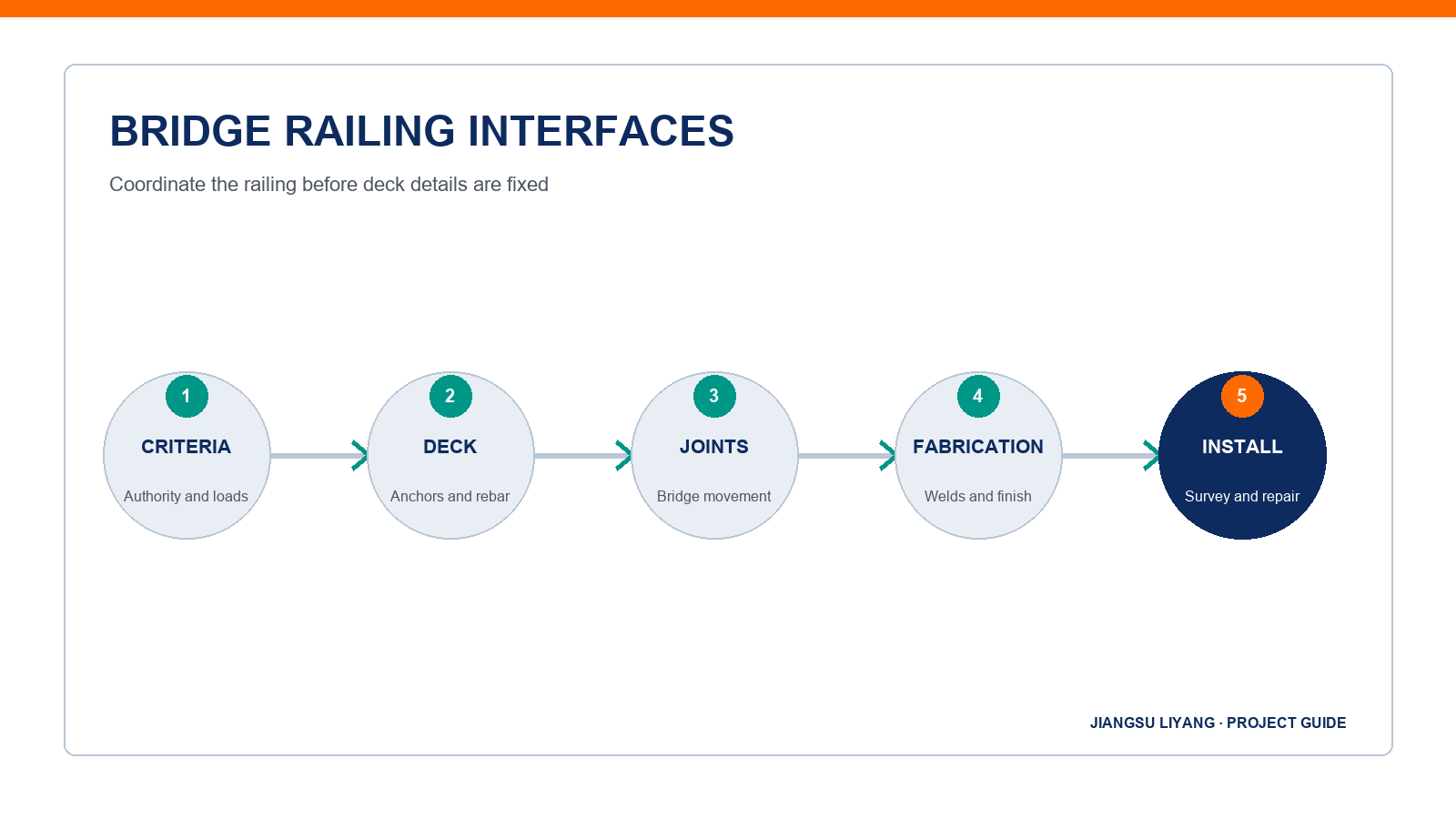
bridge pedestrian railing: the short answer
The bridge engineer and relevant authority should define the design basis, geometry and loads. The railing supplier then develops fabrication and connection details for review. Procurement should include material traceability where required, welding and coating procedures, shop drawings, trial assemblies or samples, inspection and repair instructions.
Key decisions before requesting a quotation
- Deck interface: Post bases, embeds, anchors and reinforcement zones must be coordinated before concrete placement or final deck detailing.
- Bridge movement: Expansion joints and transitions require details that accommodate movement without opening unsafe gaps.
- Drainage and debris: Base plates and lower rails should not trap water or obstruct deck drainage and cleaning.
- Environment: Deicing salts, marine exposure, humidity and maintenance access influence material and coating selection.
Turn the requirement into a coordinated project brief
A useful brief connects the product decision to the site and the people who will operate it. Confirm who approves the design, who prepares local engineering, who provides foundations or utilities, who receives the shipment and who maintains the completed installation. Record assumptions instead of leaving them inside email threads. This is especially important when the factory, project designer and installer are in different countries.
For this topic, design criteria should respond to owner/authority and bridge engineer, with codes, loads, geometry and risk requirements recorded in the project documents; interface design should respond to bridge engineer with supplier input, with anchors, reinforcement, joints and tolerances recorded in the project documents; shop detailing should respond to railing fabricator, with panels, posts, welds, fasteners and finish recorded in the project documents; verification should respond to project quality team, with submittals, inspections and records recorded in the project documents; installation should respond to qualified contractor, with survey, anchors, alignment and coating repair recorded in the project documents. That level of coordination makes it easier to detect missing scope before purchase and gives the supplier a clearer basis for drawings, samples and pricing.
Related searches such as pedestrian bridge railing, pedestrian bridge railing requirements, metal pedestrian railing often describe adjacent questions rather than separate products. They should be handled in the same decision process when the user intent overlaps, while genuinely different configurations can be supported by dedicated product or application pages.
Specification framework
| Item | What drives the decision | What to document |
|---|---|---|
| Design criteria | Owner/authority and bridge engineer | Codes, loads, geometry and risk requirements |
| Interface design | Bridge engineer with supplier input | Anchors, reinforcement, joints and tolerances |
| Shop detailing | Railing fabricator | Panels, posts, welds, fasteners and finish |
| Verification | Project quality team | Submittals, inspections and records |
| Installation | Qualified contractor | Survey, anchors, alignment and coating repair |
The table is a planning framework rather than a substitute for local professional design. Applicable codes, authority requirements and site engineering should be confirmed for the destination.
Information to include in your RFQ
A clear request for quotation helps suppliers price the same scope and reduces late revisions. Include:
- approved bridge and railing design criteria
- deck geometry and survey control
- anchor and reinforcement coordination
- movement-joint locations
- material and corrosion-protection system
- fabrication and inspection documentation
- installation access and repair procedure
Ask bidders to list inclusions, exclusions, drawings, samples, packing, delivery terms, installation boundaries, warranty and recommended spare parts. Compare lifecycle serviceability as well as initial price.
How to evaluate a supplier response
- Confirm product fit. Check that the proposed model and configuration match the site, users and intended function.
- Normalize the scope. Put every quotation against the same material, finish, accessories, logistics and installation boundary.
- Review evidence. Request dimensioned drawings, material information, finish samples and relevant project or factory evidence.
- Resolve interfaces. Identify who is responsible for foundations, utilities, unloading, assembly, testing and local approvals.
- Plan maintenance. Confirm access, cleaning, consumables, replaceable components and after-sales documentation.
Common procurement mistakes to avoid
- Comparing visual appearance before confirming deck interface and bridge movement.
- Approving a concept without documenting how drainage and debris will be verified for the actual site.
- Leaving environment, access or maintenance responsibilities until installation begins.
- Comparing a factory-only offer with a delivered or installed offer without normalizing exclusions.
- Treating a supplier’s standard configuration as proof of compliance with local codes or authority requirements.
The best value is not automatically the lowest initial quotation. A proposal that clearly defines interfaces, documentation, replaceable parts and maintenance can reduce change orders and downtime over the product’s service life.
Frequently asked questions
Can standard street railing be used on a bridge?
Only if the responsible designer verifies that it satisfies the bridge-specific geometry, loading, connection and durability requirements.
When should the railing supplier become involved?
Early enough to coordinate post spacing, anchors, reinforcement, joints, fabrication limits and transport before interfaces are fixed.
What should be checked during installation?
Anchor location and condition, post alignment, rail continuity, joint clearances, fastener control and repair of finish damage.
Discuss your project
Jiangsu Liyang supports project-based customization for overseas public-space and commercial projects. View a representative product configuration, browse our project experience, or send your drawings and requirements for a quotation.