Pedestrian railing requirements vary by country, authority, site type and fall or traffic risk. A bridge edge, roadside separator, park boundary and queue-control rail should not be specified from the same generic detail. The project designer must identify the governing rules and intended safety function before choosing height, openings, loads, foundations or materials.
For product options and fabrication capabilities, review our pedestrian railing range.
pedestrian railing requirements: the short answer
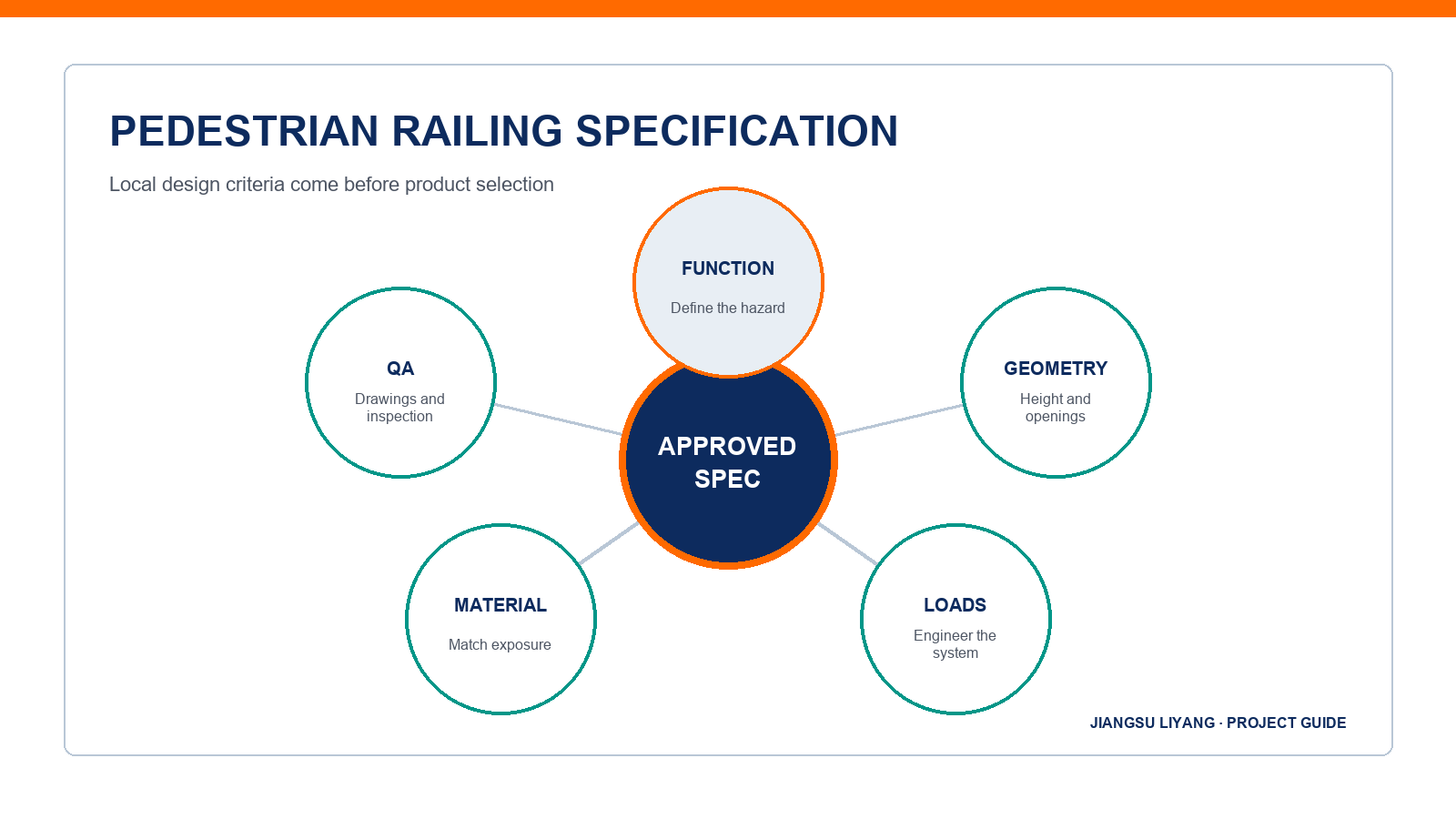
A complete specification should state the railing function, governing code or authority criteria, design loads, geometry, opening limitations, material grade, weld and fabrication expectations, corrosion protection, connection details, tolerances, submittals and inspection. The manufacturer can fabricate to approved project requirements but should not be asked to guess the local code.
Key decisions before requesting a quotation
- Safety function: Determine whether the rail prevents falls, separates pedestrians from vehicles, guides movement or protects a restricted area.
- Geometry: Height, gaps, projections, handrail needs and transitions depend on the application and local requirements.
- Loads and connections: The project engineer should define design actions and verify posts, base plates, anchors and supporting concrete.
- Durability: Material, galvanizing, coating, drainage details and repair strategy should match the exposure environment.
Turn the requirement into a coordinated project brief
A useful brief connects the product decision to the site and the people who will operate it. Confirm who approves the design, who prepares local engineering, who provides foundations or utilities, who receives the shipment and who maintains the completed installation. Record assumptions instead of leaving them inside email threads. This is especially important when the factory, project designer and installer are in different countries.
For this topic, design basis should respond to applicable code, authority and safety function, with list exact project references recorded in the project documents; geometry should respond to height, spacing, openings and transitions, with provide drawings, not only text recorded in the project documents; structure should respond to loads, posts, rails, anchors and substrate, with coordinate with civil/structural design recorded in the project documents; materials should respond to grades, welding and fasteners, with avoid ambiguous “high quality steel” language recorded in the project documents; finish and qa should respond to coating system, inspection and repairs, with define submittals and acceptance criteria recorded in the project documents. That level of coordination makes it easier to detect missing scope before purchase and gives the supplier a clearer basis for drawings, samples and pricing.
Related searches such as pedestrian guardrail specifications, pedestrian railing, pedestrian guardrail often describe adjacent questions rather than separate products. They should be handled in the same decision process when the user intent overlaps, while genuinely different configurations can be supported by dedicated product or application pages.
Specification framework
| Item | What drives the decision | What to document |
|---|---|---|
| Design basis | Applicable code, authority and safety function | List exact project references |
| Geometry | Height, spacing, openings and transitions | Provide drawings, not only text |
| Structure | Loads, posts, rails, anchors and substrate | Coordinate with civil/structural design |
| Materials | Grades, welding and fasteners | Avoid ambiguous “high quality steel” language |
| Finish and QA | Coating system, inspection and repairs | Define submittals and acceptance criteria |
The table is a planning framework rather than a substitute for local professional design. Applicable codes, authority requirements and site engineering should be confirmed for the destination.
Information to include in your RFQ
A clear request for quotation helps suppliers price the same scope and reduces late revisions. Include:
- project location and governing authority
- railing function and risk condition
- approved geometry and design loads
- supporting slab or foundation information
- material and coating system
- shop-drawing and sample requirements
- inspection, touch-up and handover documentation
Ask bidders to list inclusions, exclusions, drawings, samples, packing, delivery terms, installation boundaries, warranty and recommended spare parts. Compare lifecycle serviceability as well as initial price.
How to evaluate a supplier response
- Confirm product fit. Check that the proposed model and configuration match the site, users and intended function.
- Normalize the scope. Put every quotation against the same material, finish, accessories, logistics and installation boundary.
- Review evidence. Request dimensioned drawings, material information, finish samples and relevant project or factory evidence.
- Resolve interfaces. Identify who is responsible for foundations, utilities, unloading, assembly, testing and local approvals.
- Plan maintenance. Confirm access, cleaning, consumables, replaceable components and after-sales documentation.
Common procurement mistakes to avoid
- Comparing visual appearance before confirming safety function and geometry.
- Approving a concept without documenting how loads and connections will be verified for the actual site.
- Leaving durability, access or maintenance responsibilities until installation begins.
- Comparing a factory-only offer with a delivered or installed offer without normalizing exclusions.
- Treating a supplier’s standard configuration as proof of compliance with local codes or authority requirements.
The best value is not automatically the lowest initial quotation. A proposal that clearly defines interfaces, documentation, replaceable parts and maintenance can reduce change orders and downtime over the product’s service life.
Frequently asked questions
Is there one international pedestrian railing standard?
No. Projects must follow the code, transport authority or owner requirements applicable to the location and use.
Can a manufacturer select the railing height?
A manufacturer can propose a system, but the project designer or authority should approve the required geometry.
What prevents premature corrosion?
Appropriate materials, surface preparation, a suitable coating system, drainage-conscious detailing, careful handling and repair of damaged areas.
Discuss your project
Jiangsu Liyang supports project-based customization for overseas public-space and commercial projects. View a representative product configuration, browse our project experience, or send your drawings and requirements for a quotation.